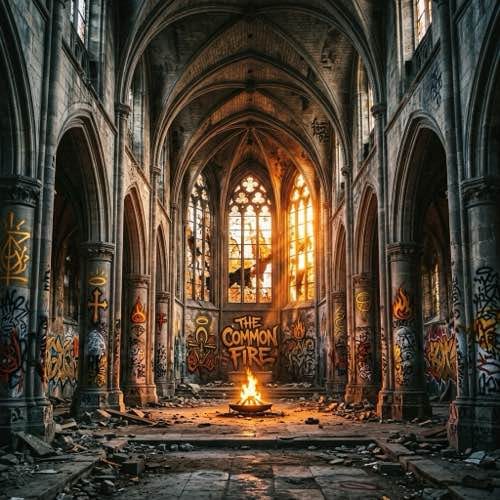
The Common Fire
The Architect of Fire
Ten songs in twenty languages about the things every human culture already agrees on and somehow forgot. Banned by Bandcamp for AI-assisted production. Now living here, on infrastructure I own.
🔥 The Tracks
Every word on this album was researched for accuracy, pronunciation, and cultural respect. Below is the full lexicon — native script, phonetics, meaning, and context — for every non-English phrase across all ten tracks.
⚡ Quick Reference
| Term | Language | Say It | Meaning | Track |
|---|---|---|---|---|
| Agni (अग्नि) | Sanskrit | AHG-nee | Fire / fire god | Agni |
| Esh (אֵשׁ) | Hebrew | EHSH | Fire | Agni |
| Pyr (πῦρ) | Greek | PEER | Fire | Agni |
| Nar (نار) | Arabic | NAHR | Fire | Agni |
| Hi (火) | Japanese | HEE | Fire | Agni |
| Huǒ (火) | Mandarin | HWAW | Fire | Agni |
| Iná | Yoruba | EE-NAH | Fire | Agni |
| Feu | French | FUH | Fire | Agni |
| Mama | Universal | MAH-MAH | Mother | Mother Tongue |
| Sol | Spanish | SOHL | Sun | Sol |
| Soleil | French | SOH-LAY | Sun | Sol |
| Taiyō (太陽) | Japanese | TAI-YOH | Sun | Sol |
| Shams (شمس) | Arabic | SHAHMS | Sun | Sol |
| Saudade | Portuguese | SOW-DAH-JEE | Beautiful ache of absence | Salt |
| L'chaim (לחיים) | Hebrew | leh-KHAI-eem | To life! | Wedding Song |
| Ubuntu | Nguni | OO-BOON-TOO | I am because you are | The Commons |
| Waheguru (ਵਾਹਿਗੁਰੂ) | Sikhism | WAH-heh-goo-ROO | Wonderful God | Different Churches |
| Oyasumi | Japanese | OH-YAH-SOO-MEE | Good night | Satoshi's Lullaby |
| Arigatō | Japanese | AH-REE-GAH-TOH | Thank you | Satoshi's Lullaby |
🔥 Track 1: Agni — Fire in Every Language
Agni (अग्नि) — Sanskrit. The Hindu god of fire and one of the oldest deities in the Rigveda. The sacred fire of rituals, weddings, cremations. When you say "Agni," you're naming the god and the element — both are true simultaneously in Hindu thought.
Esh (אֵשׁ) — Hebrew. Fire. Used in Genesis, in Moses's burning bush, and throughout the Hebrew Bible.
Pyr (πῦρ) — Ancient Greek. Root of "pyre," "pyromania," "pyrotechnic." Used by Heraclitus who said "everything is fire."
Nar (نار) — Arabic. In the Qur'an, used for both earthly fire and divine fire.
Hi (火) — Japanese. One syllable. Also means "day" with a different kanji — a cosmic shortcut.
Huǒ (火) — Mandarin. Same character as Japanese. One of the Five Elements (五行).
Iná — Yoruba. In Yoruba spiritual tradition, fire is associated with Ṣàngó (Shango), the thunder orisha, and with ritual purification.
Feu — French. Also idiomatic: "mettre le feu" = "to set fire" / "to kill it."
The Climactic Chant: AGNI! ESH! PYR! NAR! HI! HUO! INA! FEU! TUL! FUEGO! APOY! MOTO!
❤️ Track 2: Mother Tongue — "Mama" Across Languages
This track runs on the mama-papa universal — the linguistics phenomenon that most unrelated languages have a word for "mother" starting with "m" + open vowel. Babies just... make that sound first. (Linguist Roman Jakobson, 1960.)
| Word | Language | Say It |
|---|---|---|
| Mama | Spanish / English | MAH-MAH |
| Maman | French | mah-MAHN |
| Omma (엄마) | Korean | UM-mah |
| Ima (אמא) | Hebrew | EE-mah |
| Anne | Turkish | AHN-neh |
| Mor | Swedish | MOHR |
| Nanay | Tagalog | nah-NAI |
| Umm | Arabic | OOM |
☀️ Track 3: Sol / Soleil / 해 — The Sun Doesn't Pick Sides
| Word | Language | Say It | Notes |
|---|---|---|---|
| Sol | Spanish/Latin | SOHL | Root of "solar" |
| Soleil | French | soh-LAY | Strong romantic register |
| Taiyō (太陽) | Japanese | TAI-YOH | |
| Shams (شمس) | Arabic | SHAHMS | Feminine noun |
| Hae (해) | Korean | HAY | Also means "year" |
| Inti | Quechua | EEN-tee | Incan sun god |
| Ra | Egyptian | RAH | Ancient sun god |
| Lā | Hawaiian | LAH | Sun and day |
The Bridge: "El sol sale para todos" (Spanish) · "Le soleil se lève pour tous" (French) · "Minna no taiyō" (Japanese) · "Modu-ui hae" (Korean) — all meaning "The sun rises for everyone."
🧂 Track 4: Salt
Salarium — Latin for "salt-money." The origin of the word "salary." Roman soldiers were partly paid in salt.
Saudade — Portuguese (Cape Verdean). The beautiful ache of missing something you love. This word has no English equivalent — it rides untranslated in the song.
Morna — Cape Verdean music genre (Cesária Évora's signature style). The soul of the islands.
Mijo — Spanish contraction of mi hijo ("my son"). Warm, familiar. The closing tenderness.
💃 Track 5: The Wedding Song For Everybody
Every wedding on Earth has a circle dance. This track names them all:
| Dance | Origin | What It Is |
|---|---|---|
| Hora | Jewish/Romanian | Circle dance at weddings |
| Dabke | Lebanese/Palestinian | Foot-stomping line dance |
| Bhangra | Punjabi | Harvest celebration |
| Tarantella | Italian (Naples) | Spinning courtship dance |
| Céilí | Irish | Group folk dance |
| Samba | Brazilian | Rhythmic partner dance |
| Sema | Sufi (Turkish) | Whirling meditation |
Shikgu (식구) — Korean. Literally "eating mouth." Extended meaning: family member. In Korean, to be family is to eat together.
The Toasts: Opa! (Greek) · Haida! (Punjabi) · L'chaim! (Hebrew) · Kanpai! (Japanese) · Prost! (German) · Salud! (Spanish) · Skål! (Scandinavian)
🌾 Track 6: The Commons
Before the king, before the deed, before the fence — every culture had a word for shared land:
| Term | Culture | Say It | Meaning |
|---|---|---|---|
| Iriai (入会) | Japan | EE-ree-ai | Communal forests/meadows |
| Ayllu | Quechua (Andes) | AI-yoo | Kinship-based communal land |
| Jamaa | Swahili | jah-MAH | Extended family/community |
| Ahupuaʻa | Hawaiian | ah-hoo-poo-AH-ah | Mountain-to-sea land unit |
| Obshchina | Russian | OHB-sh'chee-nah | Peasant village commune |
Earth words in the hook: Tierra (Spanish) · Terra (Latin) · Ji 地 (Japanese) · Zemlya (Russian) · Ardh أرض (Arabic)
🧠 Track 7: Different Churches, Same God
Eight mystical traditions. Eight centuries. One sentence translated eight ways:
| Name | Tradition | Say It |
|---|---|---|
| Allah (الله) | Islam | ah-LAH |
| Elohim (אלהים) | Judaism | eh-loh-HEEM |
| Brahman (ब्रह्मन्) | Hinduism | BRAH-mun |
| Tao (道) | Taoism | DOW |
| Waheguru (ਵਾਹਿਗੁਰੂ) | Sikhism | WAH-heh-goo-ROO |
| Ahura Mazda | Zoroastrianism | ah-HOO-rah MAHZ-dah |
The mystics who winked: Rumi (Sufi), Meister Eckhart (Christian), Kabir (Hindu-Muslim), Laozi (Taoist), Hafez (Persian), Hildegard von Bingen (Benedictine), Dōgen (Zen), Mirabai (Bhakti Hindu)
🪙 Track 8: Satoshi's Lullaby
Satoshi Nakamoto — the pseudonymous creator of Bitcoin who published the whitepaper, launched the network, then walked away. Never spent their coins. Never revealed their identity. The most revolutionary act was leaving.
Oyasumi (おやすみ) — Japanese for "good night." Warm, familial.
Arigatō (ありがとう) — "Thank you." Literally derives from "arigatashi" — something so rare it's precious.
Genesis block — the first block of the Bitcoin blockchain, mined January 3, 2009. Contains a hidden message: a Times headline about bank bailouts.
💀 Track 9: The Ancestors Are Laughing
Four musical traditions woven into one song about the dead who are still with us:
Kora — West African 21-string harp. The griot's instrument. Carries genealogies and histories.
Second-line — New Orleans brass band tradition. The "second line" is the crowd that follows the band, dancing. A funeral becomes a parade.
Irish wake fiddle — The tradition of celebrating the dead with music, drinking, and storytelling. Grief and joy in the same room.
Norteño — Mexican folk music from the northern border. Accordion and bajo sexto. Working-class stories.
Día de los Muertos — Mexican Day of the Dead. Not mourning — visiting. The dead come home for dinner.
🌍 Track 10: The Overview
The Overview Effect — a documented cognitive shift reported by astronauts who see Earth from space. The borders disappear. The atmosphere is paper-thin. National identity dissolves into species identity.
Pale Blue Dot — Carl Sagan's name for Earth as photographed by Voyager 1 from 6 billion kilometers. "Everyone you love, everyone you know, everyone you ever heard of... lived there — on a mote of dust suspended in a sunbeam."
Earthrise — the photograph taken by Apollo 8 astronaut William Anders on December 24, 1968. Often credited as the image that launched the environmental movement.
🎨 Native Scripts — The Visual Fire
For album art, lyric videos, and printed materials — the native scripts stacked together are one of the strongest visual signals of what this album is:
अग्नि · אֵשׁ · πῦρ · نار · 火 · Iná · Feu
太陽 · شمس · 해 · Soleil
엄마 · אמא · Maman · 妈妈
ब्रह्मन् · الله · 道 · ਵਾਹਿਗੁਰੂ
入会 · Ahupuaʻa · Obshchina · Ayllu
おやすみ · ありがとう
Every script above appears in the music. Every word was researched. Every culture was consulted. The fire speaks all languages because it was here before any of them.
The Story Behind The Fire
Each track has an essay. Rolling out weekly at prometheusops.com/blog.
Subscribe to the newsletter — free, direct, on infrastructure I own.
📄 Read the academic paper — "The Common Fire: Universal Cultural Constants in Multilingual Music Production" (Zenodo, 2026). DOI: 10.5281/zenodo.19763156