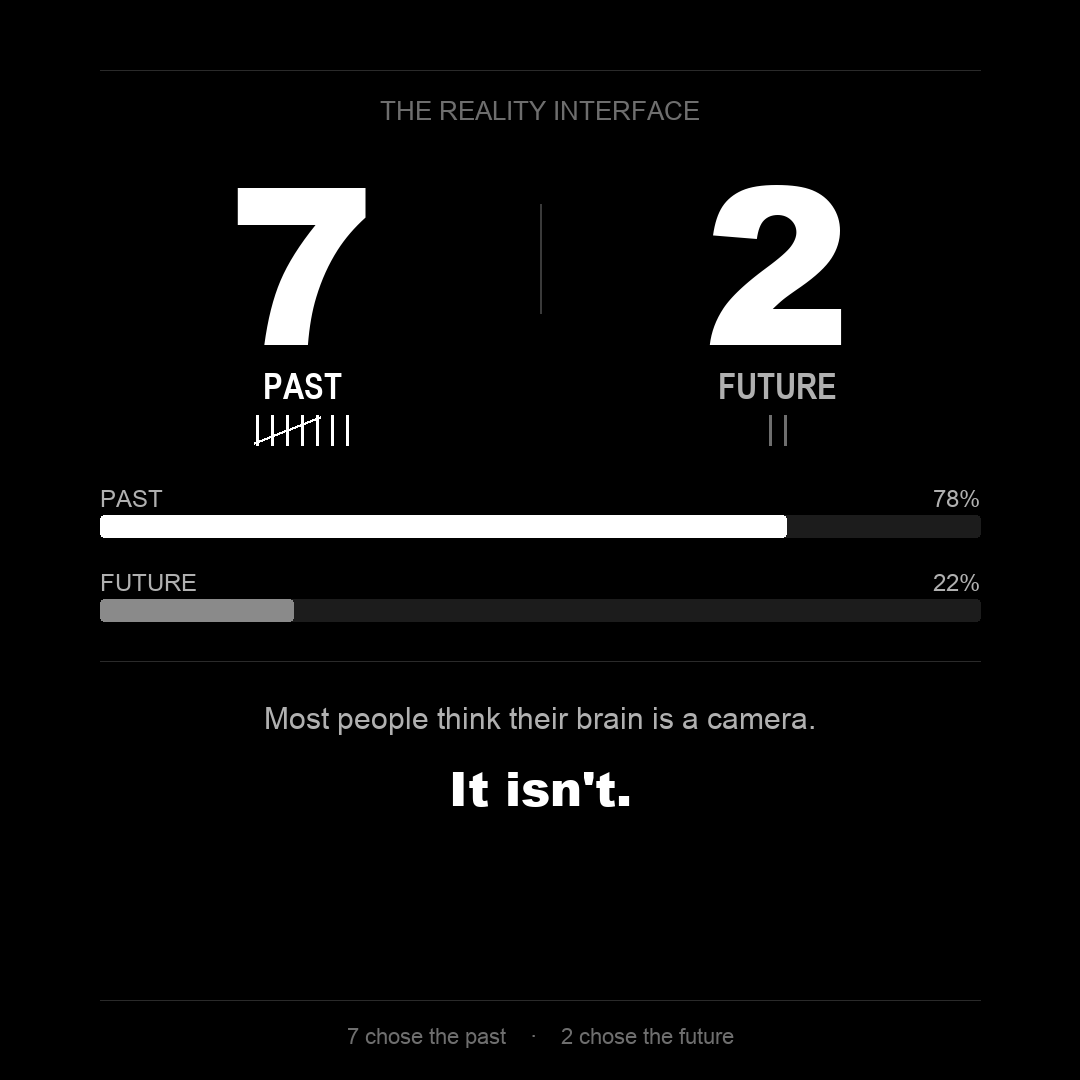
I put one question on a whiteboard.
Would you rather live 100 years in the past — or 100 years in the future?
Seven marks for the past.
Two for the future.
On paper, that vote is absurd. A century ago meant no antibiotics, no air conditioning, a shorter life, and a front-row seat to catastrophe. The past still won — because it felt safer.
That is not preference. That is software.
Most of us walk through life under a quiet, flattering assumption: that our brains are high-definition cameras, recording objective reality and filing it away for accurate playback later.
They aren’t.
Evolution did not build the human brain to show us objective truth. It built a survival tool. Perception is a user interface. You do not need the raw voltages, logic gates, and millions of lines of code just to click an icon and send a message. Seeing the source code of reality would probably freeze you in place. So the brain hides the code, simplifies the world into useful icons, and edits memory into a coherent story that keeps you moving.
That interface kept our ancestors alive on the savannah.
It is terrible at judging history, technology, or the state of the world.
Pull the curtain back on the editing suite and you start to see why people are so reliably wrong about both the past and the present.
Rosy Retrospection: The Brain’s PR Department
Ask a room whether they would rather live a hundred years back or a hundred years forward, and a surprising majority chooses the past. The whiteboard already proved it.
Psychologists call this rosy retrospection. Memory is not an archive. It is a reconstruction. The brain acts like an aggressive PR department trimming the highlight reel.
Over time, minds quietly delete the boring, low-grade friction of the past — waiting in line at the bank before 3:00 PM, getting lost with a folding paper map, sitting on hold for forty minutes, digging through a physical filing cabinet — while keeping the emotional vibe intact.
The past is already over. It carries zero uncertainty. It feels like a cozy movie set where you already know the ending. The future is a blank slate, and threat-detection wiring fills blank slates with worst-case scenarios.
So when people look back thirty years and insist life was “simpler” or “more efficient,” they are usually misremembering. They are not missing efficiency. They are missing lower friction per interaction — and their brains have erased the hours of tedium that used to come free with it.
Four Blind Spots We Are Building Right Now
It is easy to laugh at nostalgia in someone else. It is harder to catch the same cognitive software running in your own head today. Four illusions quietly distort how we read the modern world.
1. The Illusion of Being Informed
Because we carry a live firehose of global data in our pockets, it is easy to feel like we have a God’s-eye view of reality. Every breaking story, market swing, and political argument lands on the screen in real time.
In practice, we are not looking at the whole world. We are staring through a tiny, algorithmically cropped keyhole. Modern feeds are not optimized for proportional truth. They are optimized for engagement — which almost always means outrage, novelty, and threat.
We mistake the volume of information we consume for the accuracy of our perception. Ten thousand data points a day does not make you informed if nine thousand were selected to spike your cortisol.
2. The Rational Decision-Maker Myth
Almost everyone is convinced they operate like a careful scientist: gather the facts first, weigh the evidence, arrive at a logical conclusion second.
Neuroscience and behavioral psychology paint a humbler picture. In most situations, the subconscious makes an instant emotional snap judgment in milliseconds — mood, tribal identity, status, past bias. The conscious “rational” mind shows up afterward, less like a judge and more like a high-priced defense attorney inventing logical-sounding arguments for a verdict already reached.
When we argue online or debate the state of the world, we are rarely exchanging facts. We are trading post-hoc legal briefs for gut feelings.
3. Perpetual Declinism
Listen closely at work, at family dinners, or online, and you will hear the same refrain: Things used to be better. People used to have more patience. Everything is falling apart right now.
That is perpetual declinism — the stubborn belief that society peaked roughly twenty-five years ago and is now in a unique, terminal spiral. The catch is that every generation in recorded history has believed the same thing.
- In 20 BC, the Roman poet Horace lamented that his generation was morally inferior to his parents’, and warned their children would be worse.
- Socrates worried that writing would rot human memory and give young people the hollow illusion of wisdom.
- In the 1890s, critics panicked that daily newspapers and bicycles were overstimulating nervous systems and destroying face-to-face community.
Every generation thinks it is witnessing an unprecedented collapse. It is usually reading the same ancient script with the nouns swapped out. Brains are hardcoded to magnify present danger and friction while muting the baseline misery of the past. In the moment, the decline always feels urgent and undeniable. You only see the loop when you zoom out.
4. Future Nostalgia for the 2020s
Fast-forward twenty years.
Right now the 2020s feel loud, fragmented, and exhausting. Broken customer-service chatbots. Algorithmic noise. Screen fatigue. The disorienting speed of AI. It feels impossible to imagine anyone romanticizing this era.
If human psychology holds — and it has for thousands of years — there will be a generation in the 2040s waxing poetic about the “grounded, tactile days of the 2020s.” They will look back fondly on the era when you still typed on glass with your thumbs, drove your own car, argued with real humans on forums, and could still tell where the physical world ended and the digital one began.
Our current chaos is already being processed into someone else’s future golden age.
What Awareness Buys
Recognizing these blind spots does not make you immune. You cannot uninstall the human operating system. You cannot turn off the user interface just by reading about it. You will still catch yourself romanticizing your youth, mistaking your feed for the real world, and feeling a sudden certainty that the sky is falling faster than it ever has before.
What awareness buys is a little distance.
The next time you feel certain that the past was effortlessly better — or that the present is uniquely doomed — pause. Check the screen.
You might not be looking at reality at all.
Just the icons your brain put there to help you get through the day.
Seven to two. The whiteboard already knew.