An hour. Twenty messages. Five dollars.
A system built to move money into a prison could not complete the transaction it exists to complete. Then it produced a sentence more revealing than its error code:
This product is not currently available for Aric.
The infographic below is the short version. The full argument follows.
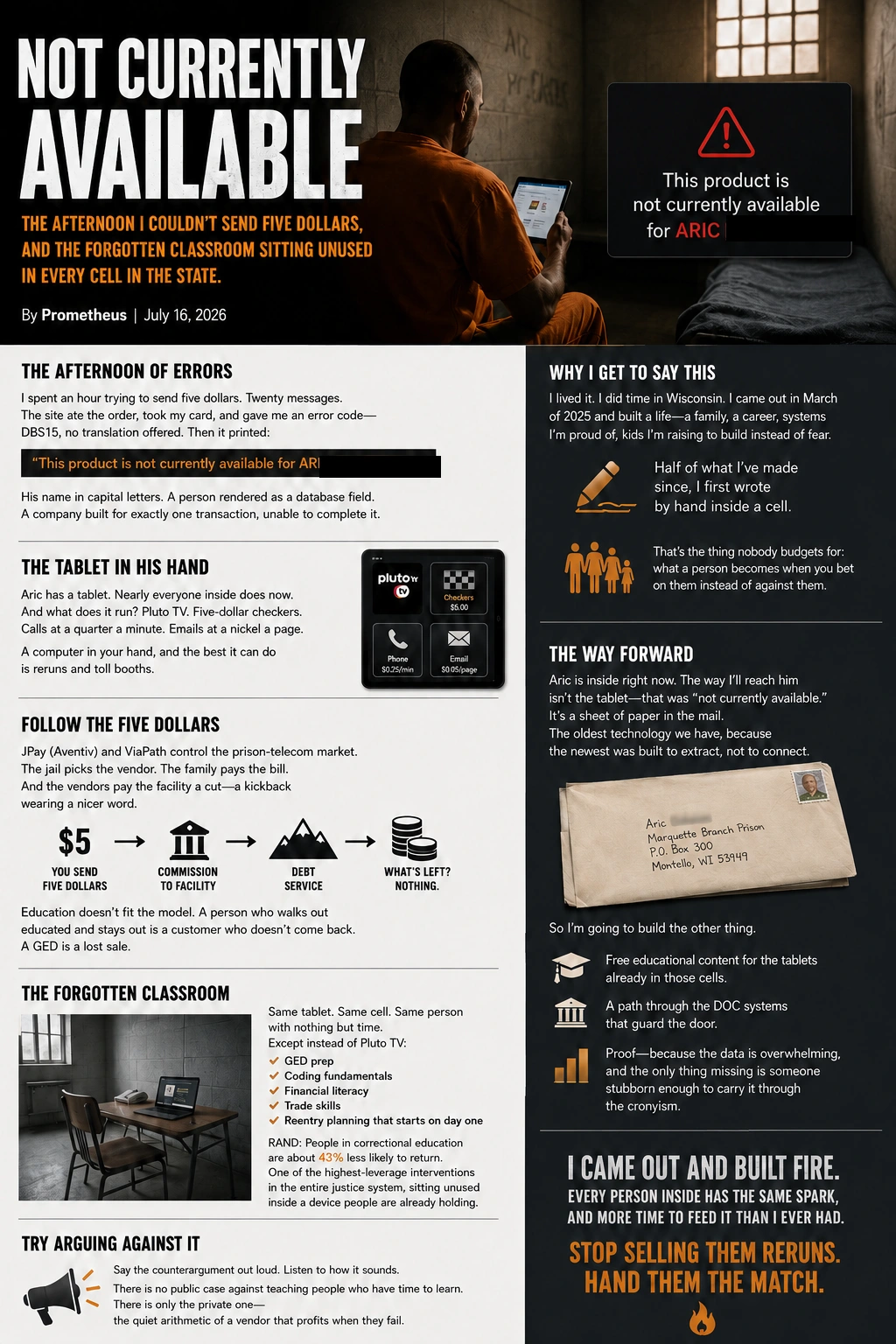
Prison tablets could be classrooms. Too often, they are storefronts and tollbooths—while proven educational tools remain outside the gate.
The System’s Own Words
I spent an hour trying to send five dollars.
Not to a bank. Not across an ocean. To a person sitting in prison with a tablet in his hand.
Twenty messages. Five dollars. The site ate the order at the confirmation screen, took the card number, handed back an error code—DBS15, no translation offered—and printed a sentence I could not stop thinking about:
This product is not currently available for Aric.
His name in capital letters. A person rendered as a database field. A company built for exactly one transaction, unable to complete it.
The Tablet In His Hand
Aric has a tablet. Nearly everyone inside does now.
And what does it run?
Pluto TV. Five-dollar checkers. Calls by the minute. Emails by the page.
A computer in your hand, and the best it can do is reruns and tollbooths.
That is not a technology problem. That is a purpose problem.
Follow The Five Dollars
JPay sits under Aventiv, alongside Securus. ViaPath is the other major force in the prison-technology market.
In this market, the person paying is not the person choosing. The facility selects the vendor. The family pays. The incarcerated person cannot take their business somewhere else.
Contracts have long included “site commissions”—payments from providers to correctional authorities. The name is polite. The incentive is not.
So follow the five dollars.
A few pennies cover the actual cost of moving a message or a payment. The rest moves through a system where every captive interaction can become a toll.
Nothing about that is inevitable. It is design.
The Forgotten Classroom
Now picture the version that should exist.
Same tablet. Same cell. Same person. Same long hours. But instead of reruns and tollbooths:
- GED prep
- Coding fundamentals
- Financial literacy
- Trade skills
- Reentry planning from day one
RAND found that people who participated in correctional education had 43 percent lower odds of recidivating, translating to about a 13-percentage-point reduction in risk.
That makes correctional education one of the highest-leverage interventions in the entire justice system. It is sitting unused inside a device people are already holding.
The Incentives Are Enough
No conspiracy is required. The incentives are enough.
The system has learned how to monetize communication, entertainment, and waiting. Education remains an add-on when it should be the device’s central purpose.
Say the counterargument out loud:
We do not want them learning to read better. We do not want them studying a trade. We do not want them building the skills that make return less likely.
Say it into a microphone. Listen to how it sounds.
There is no public case against teaching people who have time to learn. There is only the private arithmetic of a system that profits when people fail.
The Fight
The way forward is not complicated.
Free educational content for the tablets already inside those cells. A path through the Department of Corrections systems that guard the door. Proof, because the data is overwhelming and the only thing missing is someone stubborn enough to carry it through the cronyism.
Every person inside has the same spark, and more time to feed it than I ever had.
Stop selling them reruns.
Hand them the match.
Sources
- RAND Corporation: Evaluating the Effectiveness of Correctional Education
- Federal Communications Commission: Incarcerated People’s Communications Services