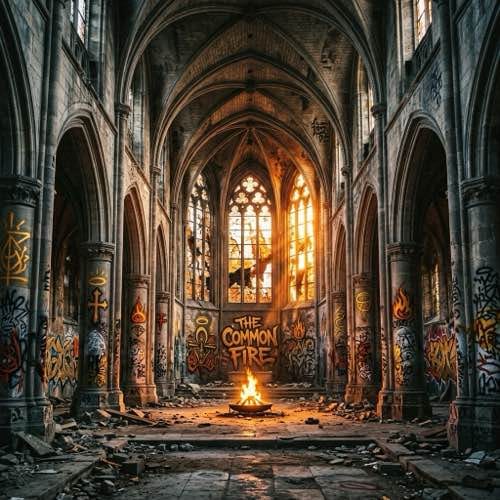
In 1381, the peasants of England marched on London and demanded the abolition of lordship, the redistribution of church lands, and the right to graze their animals on the commons. They were crushed.
In 1525, German peasants issued the Twelve Articles demanding the restoration of common forests, common fishing, and common hunting. They were slaughtered.
In the 1640s, the English Diggers planted vegetables on common land as political theater. They were dispersed.
In the 1840s, Irish peasants starved while grain left Irish ports because they no longer had access to the common lands that had fed them for centuries. Over a million died. The land they’d used for a thousand years had been enclosed by British landlords.
In 1910, the Mexican Revolution was largely fought by peasants demanding the return of ejido lands — communal village holdings that Porfirio Díaz had privatized and handed to hacendados. Emiliano Zapata’s army rode under the banner Tierra y Libertad. Land and liberty.
Look at what those all have in common.
Every peasant revolt in history was the same revolt. Not similar. The same. Across centuries, across continents, across languages. The demand was always three words: give it back. Give back what was always ours. Give back what you stole when we weren’t looking. Give back the meadow, the well, the forest, the fire.
What Got Stolen
Here’s what most of modern life doesn’t teach you.
For the vast majority of human history — eighty thousand years, maybe more — land was not individually owned. Land was held in common. The village had a meadow that everyone grazed. A forest that everyone gathered in. A well that everyone drew from. A river that everyone fished. These were not anarchy. They had rules. Strict rules. Carefully managed. Enforced by the community. Handed down through generations.
The Japanese called it iriai — communal forests with detailed rotation systems. The Andean Quechua called it ayllu — kinship-based communal land units. The Swahili-speaking peoples of East Africa called it jamaa. In Hawaiʻi, the ahupuaʻa — wedge-shaped units running from mountain to sea, collectively stewarded. In Russia, the obshchina — village land held in common and redistributed periodically to keep any one family from accumulating too much. The Iroquois Confederacy had the Great Law of Peace, which explicitly stated: land belongs not to the living, but to the unborn.
Every continent, independently, arrived at the commons. Because the commons works. It has always worked. It is the oldest working technology humans ever invented.
Then a specific thing happened.
In 16th-century England, landlords realized they could make more money running sheep than allowing peasants to grow food. So they enclosed the commons. Fenced off the land. Passed laws making it illegal for peasants to graze there. Peasants who had used that land for ten generations were suddenly criminals on soil their grandparents had tilled. Millions were forced into cities as wage labor. The landlords got rich. The cities got crowded. The factories got workers.
That was the origin of industrial capitalism. Not innovation. Not entrepreneurship. Theft. Large-scale, legislated, violently enforced theft of the commons.
And what happened in England in the 1500s then happened, over and over, everywhere capitalism spread. The Scottish Clearances. The American Indian Removal Act. The Irish Famine. The African colonial enclosures. The ejido dissolutions. The Russian collectivizations (a different direction, same pattern of power grabbing the land). The Brazilian bandeirante expansions. Each one was the same event: land that had been commons became land that belonged to someone, and the people who’d been there were either evicted, priced out, or converted into labor.
The Economist Who Proved The Peasants Right
In 2009, an economist named Elinor Ostrom won the Nobel Prize.
She’d spent her career on a question most economists dismissed: do commons actually work? The orthodoxy, derived from Garrett Hardin’s 1968 essay The Tragedy of the Commons, was that commons always fail — that shared resources inevitably get overused and destroyed unless they’re either privatized or government-controlled.
Ostrom ran the numbers. She went to the Swiss Alps and studied centuries-old pastures that had been communally managed for 800 years without degrading. She went to Maine and studied lobster fisheries that had been self-governed by the fishermen themselves for generations without regulation. She went to Nepal and studied irrigation systems designed and maintained by farmers with no state intervention for centuries. She went to Japan and found the iriai commons still functioning.
She documented thousands of successful commons, operating across centuries, all over the world, without kings, without corporations, without cops, without cages. All self-governed by communities who had worked out their own rules and enforced them together.
She published eight design principles for successful commons. They were not radical. They were not utopian. They were observations: rules need to match local needs; users need to participate in modifying the rules; monitoring needs to happen; graduated sanctions; conflict resolution mechanisms. Boring. Technical. Engineering-grade.
The commons is not a dream. The commons is a functioning technology that humans have used for eighty thousand years.
The peasants were right. Hardin was wrong. The orthodoxy was a lie that justified enclosure. Ostrom got the Nobel for pointing out that millions of working commons had been sitting in plain sight the whole time, and economics had refused to look at them because looking at them would have embarrassed the theory of why we should keep privatizing things.
What We Still Have
Right now, in 2026, we still have commons.
The atmosphere is a commons. No one owns the air. (Yet.)
Language is a commons. No one owns English. No one can charge you to speak.
Mathematics is a commons. The Pythagorean theorem cannot be patented.
The internet, as a protocol, is a commons. HTTP. TCP/IP. Open standards. Anyone can run a server. (Though platforms on top of it are very much not commons — Facebook, YouTube, Twitter are enclosed fields pretending to be public squares.)
Open-source software is a commons. Linux. Git. Python. The stacks every tech company profits from.
Bitcoin, as a protocol, is a commons. Nobody owns the network. Anyone can run a node.
And personal AI, if we do it right, is the next commons. The next fire. The next thing where a single question determines everything: will this be hoarded by a handful of corporations, or will it be distributed to every person on Earth?
That question is in the air right now. The enclosure is being attempted right now. It is not too late, but it is getting later by the day.
The Song
The Commons opens with a Celtic tin whistle and sheep bells and spoken word about the meadow. Then the groove comes in — West African kora, Appalachian banjo, bluegrass fiddle. Then the house-music kick drum explodes underneath and turns it into a rave.
The structure is the argument. Folk traditions and festival electronics, collapsed onto each other — because the commons spans both. The same fight is happening now that was happening in 1381. Different dance. Same meadow.
The hook: “this land was never yours to sell / this land was always ours to tell / the commons, the commons, the commons.”
Take it back.
🔥 Listen for free: https://prometheusops.com/music/ Subscribe: https://buttondown.com/jebb
Next Monday: Different Churches, Same God. What the mystics quietly agreed on.